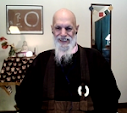


May 15 is International Conscientious Objectors Day, so happy CO Day to one and all.
On this day, may we all remember the pain and suffering caused by war, and especially for us in the United States of American Brand of facism, may we remember those who are hurt, injured, and dying caused by American-made weapons.
May all beings be happy and well.
Friday, May 15, 2009


Thursday, March 12, 2009
The Great Pattern of the Dharma
Seeing patterns is what the word Dharma means. I have always thought that
it was a bit of a mistake to interpret Dharma as "the Law" rather than "the
Pattern" because people in the West will think Buddha's Law is like God's
Law, something decreed rather than something recognized. Dharma means the
Law in the sense of the Laws of Nature or the Laws of Physics, not the laws
of society or laws handed down by a parental god figure. And the laws of
nature and physics are the determination of patterns of regularity, or lack
thereof.
The Buddha Dharma is the pattern recognition regarding human awakening. The
Dharma is the body of the Laws of Consciousness and of how the
discrimination of mind creates the variegated patterns of illusion and
delusion and how the suffering created by the illusions and delusions may be
overcome by the freedom of seeing how the patterns of daily life are
manifesting the Great Pattern of the Laws of Consciousness.
it was a bit of a mistake to interpret Dharma as "the Law" rather than "the
Pattern" because people in the West will think Buddha's Law is like God's
Law, something decreed rather than something recognized. Dharma means the
Law in the sense of the Laws of Nature or the Laws of Physics, not the laws
of society or laws handed down by a parental god figure. And the laws of
nature and physics are the determination of patterns of regularity, or lack
thereof.
The Buddha Dharma is the pattern recognition regarding human awakening. The
Dharma is the body of the Laws of Consciousness and of how the
discrimination of mind creates the variegated patterns of illusion and
delusion and how the suffering created by the illusions and delusions may be
overcome by the freedom of seeing how the patterns of daily life are
manifesting the Great Pattern of the Laws of Consciousness.
Sunday, February 01, 2009
A Case of Mistaken (Fish) Identity
Sansheng's Golden Fish Scales
三聖金鱗
Raised: Sansheng asked Xuefeng, "[If] the golden fish scales that pass through the net are not investigated. [then] what is used for food?"
Feng said, "Wait until you come out of the net, then [I'll] speak to you."
Sheng said, "A learned and virtuous one of fifteen hundred people and [you] still don't know the 'head of the word' (huatou)."
Feng said, "[I'm] an old monk in residence managing numerous affairs."
###
The Zen koan "Sansheng's Golden Fish Scales" is included as Case 49 of the Blue Cliff Record (碧巖錄, Biyan Lu, J. Hekiganroku) and Case 33 of The Record of the Serene (從容錄, Congrong Lu, J. Shoyoroku). Unfortunately, the translations that I have come across by the Cleary brothers, Thomas and James C., (in their The Blue Cliff Record), Thomas Cleary alone (in his The Book of Serenity) and the Sanbo Kyodan lineage (on the internet at http://perso.ens-lyon.fr/eric.boix/Koan/Hekiganroku/index.html and http://perso.ens-lyon.fr/eric.boix/Koan/Shoyoroku/index.html ) leave out the important set up to the koan's gambit: that Sansheng is asking about huatou practice. All three translations state erroneously that Sansheng is asserting that the fish has come through the net, and all three leave out the reference by Sansheng in his response to the huatou.
The word huatou (話頭, J. wato) literally means "the head (頭) of the word (話).". The word "head" is used in the sense of the headwaters of a river and so it means "the source of language" itself. Zen Master Yuanwu is the commentator of The Blue Cliff Record and the huatou, method was widely popularized by his dharma heir Dahui Zonggao. In fact because of the great success of his popularizing efforts some people have mistakenly believed that Dahui actually created the huatou method. This koan is a demonstration that huatou comes directly through Linji as Sansheng is one of Linji's great dharma heirs.
What is a huatou? The koan presents a story in words. The story embodies some kind of dilemma of duality. The zen of meditation is to turn around (Skt. pravritti, as found in the Lankavatara Sutra) the flow or light of the ideation that results in duality to be aware of the source of the ideas themselves. The huatou is the kernel or pivot point of the koan upon which the focused attention can effect this "turn around" to see the source of the words.
The most famous huatou of all is in the koan Zhaozhou's "No." (Ch. "Wu", J. "Mu"). Other well known huatou center around the word "Who" such as "Who is repeating the Buddha's name?", "Who hears?" and "Who is dragging this corpse around?" Every genuine koan has its huatou that turns the attention around to point directly to the source of mind.
In Zhaoahou's famous koan, a monk asked Zhaozhou, "Does the puppy dog have Buddha Nature?" Zhou said, "No.". The mind naturally tries to reason this out by thinking about the concepts of Buddha Nature, which living beings have or do not have Buddha Nature, etc. Zhaozhou's reply is contrary to the usually held concept that all beings have Buddha Nature so another duality arises in the mind about why does he say "No"? The huatou method is to focus attention directly on the word "No" within the frame of the inquiry of what is the "head of this word"? "What is 'No'?" means what is the source of the very idea of "No"?
The Sixth Ancestor of Zen, Huineng, stated this question in the following way. "True Suchness, as it is, is the essence of thought. Thought, as it is, is the function of True Suchness." The huatou method is to focus directly on the essence or source of thought itself without being attached to the thought. As the Great Chinese Zen master Xuyun, whose life spanned the 19th and 20th centuries, said, "Hua is actually a wandering thought. You're actually talking to yourself. Before the wandering thoughts arise, one must illuminate on them. Look to see just what is the original face? This is called looking at Huatou." ( http://www.sinc.sunysb.edu/clubs/buddhism/newsletter/news35.html )
Discussing the huatou in the sentence "Who is repeating the Buddha's name?", Xuyun also said, "Before this sentence is uttered, it is called a hua t'ou (lit. sentence's head). As soon as it is uttered, it becomes the sentence's tail (hua wei).." (http://www.sinc.stonybrook.edu/Clubs/buddhism/xuyun/index.html ) The usual practice is to begin investigating a huatou by mentally uttering simple rote repetition of the huatou word or phrase. This is looking at the tail of the word not the head, but it is quite natural to begin this way. The investigation of the huatou can be said to begin with the attention going "behind" or "before" the repeated word and seeing that thoughts arise in the context of thoughtlessness as sound arises in the context of silence. The attention turns away from the word by jumping off the rote repetition to look at the question of how does the word or thought itself arise from within the context of thoughtlessness? This becomes looking directly at True Suchness or Original Face. Xuyun says, "Our minute examination should be turned inward and this is also called 'the turning inward of the hearing to hear the self-nature.'"
The fish in Sansheng's koan is none other than one's own True Suchness, Original Face, Self-nature, etc.. Sansheng's opening line says, "I don't study the golden fish scales that pass through the net." (透網金鱗未審, lit.: pass through-net-golden-fish scales-don't-study) Sansheng is saying that in his huatou practice he is not studying the words or thoughts that have already arisen in the mind, i.e., the golden fish scales that have passed through the net of the differentiating thought processes. The translations that state this sentence as "The golden fish that's passed through the net" (Cleary) or "When a fish with golden scales has passed through the net" (Sanbo Kyodan) miss this point entirely. The phrase that they translate as "golden fish" is 金鱗 and 鱗 means "fish scales" not fish. Cleary ignores this altogether and translates "fish scales" as "fish". The Sanbo Kyodan translation includes the reference to the "scales" but it inserts "fish" to make "fish with golden scales" as if it is necessarily implied.
But Sansheng is neither asserting nor implying the fish has passed through the net, he is saying the fish's golden scales, i.e., thoughts, pass through the net and he knows that these are not the subject or object of huatou practice. Sansheng's next question is the serve to Xuefeng asking how then does one do huatou practice if thought is not studied? It must be assumed that Sansheng as a Zen master in his own right has his own answer to this question and that he is putting himself in the position or role of a senior student to ask his question for the Zen drama. When teaching the huatou method Zen teachers commonly say things like, "Chew on the huatou like a dog who won't give up a bone." Sansheng's question, "[If] one doesn't study the golden fish scales that pass through the net, [then] what is used for food?" has the double entendre of asking "what is there for the meditator to chew on if one is not examining thoughts or ideas (i.e., the golden fish scales)?" and also "what does the fish (True Suchness, Original Face, etc.) itself have for food if there is no source beyond it?" (which in the theistic context is like asking "if God is the creator, who creates God?").
Xuefeng's response "Wait until you come out of the net, then I'll speak to you." has several levels of nuance. First, on the surface, it simply takes the question at its face value, and Xuefeng takes the role of the teacher saying he won't give an answer to the student because the student must find it on his own. But also Xuefeng is saying to Sansheng, "I'll wait until you stop playing games trying to catch me in your net before I talk with you." And thirdly, Xuefeng is acknowledging that Sansheng himself is the fish and when he shows himself in a straightforward manner then they can talk as equals.
Xuefeng's response is a returning challenge to Sansheng pointing out the duality of the "net" and asking, "Which side of the net are you on?" The "net" in question is known in Buddhist psychology as the Seventh Consciousness. When the undifferentiated awareness of True Suchness of the eighth consciousness passes through the seventh consciousness it is differentiated into self and environment, subject and objects. Here is how Xuyun described this process in reference to the use of the huatou:
Xuefeng's response is asking Sansheng whether he has actually transmuted the seventh consciousness or is he still holding onto and held by the net's function of discrimination?
Sansheng in order to meet Xuefeng face to face, needs to push the discussion beyond this question of the duality of which side of the net one is on. Sansheng says, "Fifteen hundred learned and virtuous people [in the assembly] and you still don't know the 'head of the word' (huatou)." Sanshang thus turns the question directly back onto Xuefeng implying "I am out the net, are you?" Sansheng's response stands as if saying that if he wasn't already out of the net then he couldn't have asked the first question as he did. On the surface he is challenging Xuefeng to the very last drop of duality saying, in effect, "You are in the teacher role here, so I asked you to say something about the huatou with my first question, and yet you, the teacher of 1,500 worthy people, refuse to reveal the huatou plainly. So does that mean you do not know the huatou, that is, the source of the mind?" Here the two Zen masters are meeting face to face and their eyebrows become entangled since already within the deeper meaning of Sansheng's response is his acknowledgment that neither he nor Xuefeng can actually say anything about the huatou as an object without becoming entangled in the net. Sansheng's saying "You still don't know the huatou" is a two-edged sword: on one edge is the upside down Zen praise of Sansheng for Xuefeng who did not fall into Sansheng's net and on the other edge is the last challenge to Xuefeng: "What can you say that shows how the huatou passes through the net to transform the net itself?"
Xuefeng's response is "[I'm] an old monk in residence managing numerous affairs." (老僧住持事繁) This response is the pure taste of Zen. It is completely plain spoken with no pretence to or perfume of any transcendent meaning. Yet, because the transcendent and the mundane are a complete unity and this unity is completely realized by Xuefeng, it is a completely transcendent statement by the huatou itself in its own words. Xuefeng's "[I'm] an old monk" (老僧) directly demonstrates the Great Mirror Wisdom of the transformed eighth consciousness. Since the statement is the statement of the huatou without any intermediation by the seventh consciousness acting as a differentiating agent mistaking things as objects, the huatou says it is "dwelling in residence" (住), thus the seventh consciousness is shown in its transformed state as the Wisdom of Equality. Xuefeng's "managing" (持) is the description of the sixth consciousness transformed into the Profound Observing Wisdom and the "numerous affairs" (事繁) being managed are the five sense consciousnesses transformed into the Perfecting Wisdom.
Now all this is just the used mouthwash of this poor student and should be immediately rinsed down the drain. If these fish scales have any value at all it could only be to encourage you to follow your meditation method diligently and not be confused by such glittering golden fish scales, so that you may personally grab the fish with your own bare hands.
_/|\_
Gregory
三聖金鱗
Raised: Sansheng asked Xuefeng, "[If] the golden fish scales that pass through the net are not investigated. [then] what is used for food?"
Feng said, "Wait until you come out of the net, then [I'll] speak to you."
Sheng said, "A learned and virtuous one of fifteen hundred people and [you] still don't know the 'head of the word' (huatou)."
Feng said, "[I'm] an old monk in residence managing numerous affairs."
###
The Zen koan "Sansheng's Golden Fish Scales" is included as Case 49 of the Blue Cliff Record (碧巖錄, Biyan Lu, J. Hekiganroku) and Case 33 of The Record of the Serene (從容錄, Congrong Lu, J. Shoyoroku). Unfortunately, the translations that I have come across by the Cleary brothers, Thomas and James C., (in their The Blue Cliff Record), Thomas Cleary alone (in his The Book of Serenity) and the Sanbo Kyodan lineage (on the internet at http://perso.ens-lyon.fr/eric.boix/Koan/Hekiganroku/index.html and http://perso.ens-lyon.fr/eric.boix/Koan/Shoyoroku/index.html ) leave out the important set up to the koan's gambit: that Sansheng is asking about huatou practice. All three translations state erroneously that Sansheng is asserting that the fish has come through the net, and all three leave out the reference by Sansheng in his response to the huatou.
The word huatou (話頭, J. wato) literally means "the head (頭) of the word (話).". The word "head" is used in the sense of the headwaters of a river and so it means "the source of language" itself. Zen Master Yuanwu is the commentator of The Blue Cliff Record and the huatou, method was widely popularized by his dharma heir Dahui Zonggao. In fact because of the great success of his popularizing efforts some people have mistakenly believed that Dahui actually created the huatou method. This koan is a demonstration that huatou comes directly through Linji as Sansheng is one of Linji's great dharma heirs.
What is a huatou? The koan presents a story in words. The story embodies some kind of dilemma of duality. The zen of meditation is to turn around (Skt. pravritti, as found in the Lankavatara Sutra) the flow or light of the ideation that results in duality to be aware of the source of the ideas themselves. The huatou is the kernel or pivot point of the koan upon which the focused attention can effect this "turn around" to see the source of the words.
The most famous huatou of all is in the koan Zhaozhou's "No." (Ch. "Wu", J. "Mu"). Other well known huatou center around the word "Who" such as "Who is repeating the Buddha's name?", "Who hears?" and "Who is dragging this corpse around?" Every genuine koan has its huatou that turns the attention around to point directly to the source of mind.
In Zhaoahou's famous koan, a monk asked Zhaozhou, "Does the puppy dog have Buddha Nature?" Zhou said, "No.". The mind naturally tries to reason this out by thinking about the concepts of Buddha Nature, which living beings have or do not have Buddha Nature, etc. Zhaozhou's reply is contrary to the usually held concept that all beings have Buddha Nature so another duality arises in the mind about why does he say "No"? The huatou method is to focus attention directly on the word "No" within the frame of the inquiry of what is the "head of this word"? "What is 'No'?" means what is the source of the very idea of "No"?
The Sixth Ancestor of Zen, Huineng, stated this question in the following way. "True Suchness, as it is, is the essence of thought. Thought, as it is, is the function of True Suchness." The huatou method is to focus directly on the essence or source of thought itself without being attached to the thought. As the Great Chinese Zen master Xuyun, whose life spanned the 19th and 20th centuries, said, "Hua is actually a wandering thought. You're actually talking to yourself. Before the wandering thoughts arise, one must illuminate on them. Look to see just what is the original face? This is called looking at Huatou." ( http://www.sinc.sunysb.edu/clubs/buddhism/newsletter/news35.html )
Discussing the huatou in the sentence "Who is repeating the Buddha's name?", Xuyun also said, "Before this sentence is uttered, it is called a hua t'ou (lit. sentence's head). As soon as it is uttered, it becomes the sentence's tail (hua wei).." (http://www.sinc.stonybrook.edu/Clubs/buddhism/xuyun/index.html ) The usual practice is to begin investigating a huatou by mentally uttering simple rote repetition of the huatou word or phrase. This is looking at the tail of the word not the head, but it is quite natural to begin this way. The investigation of the huatou can be said to begin with the attention going "behind" or "before" the repeated word and seeing that thoughts arise in the context of thoughtlessness as sound arises in the context of silence. The attention turns away from the word by jumping off the rote repetition to look at the question of how does the word or thought itself arise from within the context of thoughtlessness? This becomes looking directly at True Suchness or Original Face. Xuyun says, "Our minute examination should be turned inward and this is also called 'the turning inward of the hearing to hear the self-nature.'"
The fish in Sansheng's koan is none other than one's own True Suchness, Original Face, Self-nature, etc.. Sansheng's opening line says, "I don't study the golden fish scales that pass through the net." (透網金鱗未審, lit.: pass through-net-golden-fish scales-don't-study) Sansheng is saying that in his huatou practice he is not studying the words or thoughts that have already arisen in the mind, i.e., the golden fish scales that have passed through the net of the differentiating thought processes. The translations that state this sentence as "The golden fish that's passed through the net" (Cleary) or "When a fish with golden scales has passed through the net" (Sanbo Kyodan) miss this point entirely. The phrase that they translate as "golden fish" is 金鱗 and 鱗 means "fish scales" not fish. Cleary ignores this altogether and translates "fish scales" as "fish". The Sanbo Kyodan translation includes the reference to the "scales" but it inserts "fish" to make "fish with golden scales" as if it is necessarily implied.
But Sansheng is neither asserting nor implying the fish has passed through the net, he is saying the fish's golden scales, i.e., thoughts, pass through the net and he knows that these are not the subject or object of huatou practice. Sansheng's next question is the serve to Xuefeng asking how then does one do huatou practice if thought is not studied? It must be assumed that Sansheng as a Zen master in his own right has his own answer to this question and that he is putting himself in the position or role of a senior student to ask his question for the Zen drama. When teaching the huatou method Zen teachers commonly say things like, "Chew on the huatou like a dog who won't give up a bone." Sansheng's question, "[If] one doesn't study the golden fish scales that pass through the net, [then] what is used for food?" has the double entendre of asking "what is there for the meditator to chew on if one is not examining thoughts or ideas (i.e., the golden fish scales)?" and also "what does the fish (True Suchness, Original Face, etc.) itself have for food if there is no source beyond it?" (which in the theistic context is like asking "if God is the creator, who creates God?").
Xuefeng's response "Wait until you come out of the net, then I'll speak to you." has several levels of nuance. First, on the surface, it simply takes the question at its face value, and Xuefeng takes the role of the teacher saying he won't give an answer to the student because the student must find it on his own. But also Xuefeng is saying to Sansheng, "I'll wait until you stop playing games trying to catch me in your net before I talk with you." And thirdly, Xuefeng is acknowledging that Sansheng himself is the fish and when he shows himself in a straightforward manner then they can talk as equals.
Xuefeng's response is a returning challenge to Sansheng pointing out the duality of the "net" and asking, "Which side of the net are you on?" The "net" in question is known in Buddhist psychology as the Seventh Consciousness. When the undifferentiated awareness of True Suchness of the eighth consciousness passes through the seventh consciousness it is differentiated into self and environment, subject and objects. Here is how Xuyun described this process in reference to the use of the huatou:
Each of us has a mind which is the eighth consciousness (vijnana), as well as the seventh, sixth and the first five consciousnesses. The first five are the five thieves of the eye, ear, nose, tongue and body. The sixth consciousness is the thief of mind (manas). The seventh is the deceptive consciousness (klista-mano-vijnana) which from morning to evening grasps the eighth consciousness' "subject" and mistakes it for an "ego". It incites the sixth to lead the first five consciousnesses to seek external objects (such as) form, sound, smell, taste and touch. Being constantly deceived and tied the eighth consciousness-mind is held in bondage without being able to free itself. For this reason we are obliged to have recourse to this hua t'ou and use its "Vajra King's Precious Sword" to kill all these thieves so that the eighth consciousness can be transmuted into the Great Mirror Wisdom, the seventh into the Wisdom of Equality, the sixth into the Profound Observing Wisdom and the first five consciousnesses into the Perfecting Wisdom. It is of paramount importance first to transmute the sixth and seventh consciousnesses, for they play the leading role and because of their power in discriminating and discerning. While you were seeing the voidness and the brightness and composing poems and gathas, these two consciousnesses performed their (evil) functions. Today, we should use this hua t'ou to transmute the discriminating consciousness into the Profound Observing Wisdom and the mind which differentiates between ego and personality into the Wisdom of Equality. (Ibid.)
Xuefeng's response is asking Sansheng whether he has actually transmuted the seventh consciousness or is he still holding onto and held by the net's function of discrimination?
Sansheng in order to meet Xuefeng face to face, needs to push the discussion beyond this question of the duality of which side of the net one is on. Sansheng says, "Fifteen hundred learned and virtuous people [in the assembly] and you still don't know the 'head of the word' (huatou)." Sanshang thus turns the question directly back onto Xuefeng implying "I am out the net, are you?" Sansheng's response stands as if saying that if he wasn't already out of the net then he couldn't have asked the first question as he did. On the surface he is challenging Xuefeng to the very last drop of duality saying, in effect, "You are in the teacher role here, so I asked you to say something about the huatou with my first question, and yet you, the teacher of 1,500 worthy people, refuse to reveal the huatou plainly. So does that mean you do not know the huatou, that is, the source of the mind?" Here the two Zen masters are meeting face to face and their eyebrows become entangled since already within the deeper meaning of Sansheng's response is his acknowledgment that neither he nor Xuefeng can actually say anything about the huatou as an object without becoming entangled in the net. Sansheng's saying "You still don't know the huatou" is a two-edged sword: on one edge is the upside down Zen praise of Sansheng for Xuefeng who did not fall into Sansheng's net and on the other edge is the last challenge to Xuefeng: "What can you say that shows how the huatou passes through the net to transform the net itself?"
Xuefeng's response is "[I'm] an old monk in residence managing numerous affairs." (老僧住持事繁) This response is the pure taste of Zen. It is completely plain spoken with no pretence to or perfume of any transcendent meaning. Yet, because the transcendent and the mundane are a complete unity and this unity is completely realized by Xuefeng, it is a completely transcendent statement by the huatou itself in its own words. Xuefeng's "[I'm] an old monk" (老僧) directly demonstrates the Great Mirror Wisdom of the transformed eighth consciousness. Since the statement is the statement of the huatou without any intermediation by the seventh consciousness acting as a differentiating agent mistaking things as objects, the huatou says it is "dwelling in residence" (住), thus the seventh consciousness is shown in its transformed state as the Wisdom of Equality. Xuefeng's "managing" (持) is the description of the sixth consciousness transformed into the Profound Observing Wisdom and the "numerous affairs" (事繁) being managed are the five sense consciousnesses transformed into the Perfecting Wisdom.
Now all this is just the used mouthwash of this poor student and should be immediately rinsed down the drain. If these fish scales have any value at all it could only be to encourage you to follow your meditation method diligently and not be confused by such glittering golden fish scales, so that you may personally grab the fish with your own bare hands.
_/|\_
Gregory
Tuesday, January 27, 2009
Excerpt from the Platform Sutra
Learned and virtuous friends,
Here's my translation of the last two paragraphs of Chapter Four of the Great Master Sixth Ancestor's Dharma Treasure Platform Sutra.
I recently attended a 7-day Zen retreat (sesshin) with the Pacific Zen Institute. The PZI "Old Teacher" (Roshi) John Tarrant is working with koans in a way that harkens back to the ancient Chinese open assembly presentations of koans. In the opening talk of retreat, he presented the koan "There is one treasure hidden in the body" as a theme for the retreat.
This section of Huineng's Platform Sutra arose in mind as an appropriate context for the inquiry of this koan:
FYI:
The English term "True Suchness" is the translation of the Chinese term 真如 which is the Chinese translation of the Sanskrit Bhūtatathatā. Other possible translations could be "Actual Thusness", "Real Suchness", "Genuine Thusness," etc.
The English term "characeristics of things" is the translation of the Chinese term 法相 which is the Chinese translation of the Sanskrit dharmalaksana.
I remembered this section of the Platform Sutra from several translations including Wong Moulam, Charles Luk, and Fung and Fung, and each of course has different nuances and interpretations of the text, so I've now done my own translation to zero in on this most important section. As I see it, this section is one of the core expressions of the variations on the central theme of Huineng's teaching.
This aspect of the teaching is pointing directly to how the Eight consciousnesses function. The Eighth Constiousness (Alayavijnana) is the essence of thought spoken of here by the name True Suchness. Awareness flows as the function of True Suchness and beoomes thinking. As thinking awareness flows into the senses the objectivity and appearance of a world is formed. In meditation, the function of the koan is to direct attention and awareness to "turn around" to the essence of thinking as it arises directly from True Suchness. This turning around is the paravritti referred to in the Lankavatara Sutra.
It should be understood that the term for "thinking," as a technical term, is inclusive of all mental formations including remembrance and thus memory. In this context D.T. Suzuki wrote in his Studies In the Lankavatara Sutra:
From this we should understand that Huineng's teaching about directing awareness to that which gives rise to thinking is exactly the teaching of Bodhidharma and the Lankavatara Sutra and not be under any delusions that Huineng did not accept the teachings of the Lankavatara and in some way preferred the Diamond Cutter Sutra.
Enjoy the Dharma.
Here's my translation of the last two paragraphs of Chapter Four of the Great Master Sixth Ancestor's Dharma Treasure Platform Sutra.
I recently attended a 7-day Zen retreat (sesshin) with the Pacific Zen Institute. The PZI "Old Teacher" (Roshi) John Tarrant is working with koans in a way that harkens back to the ancient Chinese open assembly presentations of koans. In the opening talk of retreat, he presented the koan "There is one treasure hidden in the body" as a theme for the retreat.
This section of Huineng's Platform Sutra arose in mind as an appropriate context for the inquiry of this koan:
"Learned and virtuous ones. A person who is without is without what? A thoughtful person thinks of what thing? A person who is without is without the characteristics of duality and without the various dusts and troubles of the heart-mind. A thoughtful person thinks of the original nature of True Suchness. True Suchness, as it is, is the essence of thought; thought, as it is, is the function of True Suchness. One's nature of True Suchness gives rise to thinking; neither the eye, ear, nose, or tongue is able to think. True Suchness is present as nature, therefore it can give rise to thinking. If one is without True Suchness, what is regarded as seeing and hearing, color and sound, as they are at that time are destroyed.
"Learned and virtuous ones. When one's nature of True Suchness gives rise to thinking, even if the six organs are present to see and hear, perceive and know, they are not contaminated by the 10,000 objective phenomena, and the true nature is always autonomous. For this reason the [Vimalakirti Nirdesa] Sutra says, 'Being able to properly differentiate the various characteristics of things is being at the primary meaning and immovable.'"
善知識! 無者無何事?念者念何物?無者無二相,無諸塵勞之心。念者念真如本性。真如即是念之體,念即是真如之用。真如自性起念,非眼耳鼻舌能念。真如有性,所以起念;真如若無,眼耳色聲當時即壞。
善知識!真如自性起念,六根雖有見聞覺知,不染萬境,而真性常自在。故經云:『能善分別諸法相,於第一義而不動。』
[T48n2008_p0353a28(03) to T48n2008_p0353b06(02)]
http://www.cbeta.org/result/normal/T48/2008_001.htm
FYI:
The English term "True Suchness" is the translation of the Chinese term 真如 which is the Chinese translation of the Sanskrit Bhūtatathatā. Other possible translations could be "Actual Thusness", "Real Suchness", "Genuine Thusness," etc.
The English term "characeristics of things" is the translation of the Chinese term 法相 which is the Chinese translation of the Sanskrit dharmalaksana.
I remembered this section of the Platform Sutra from several translations including Wong Moulam, Charles Luk, and Fung and Fung, and each of course has different nuances and interpretations of the text, so I've now done my own translation to zero in on this most important section. As I see it, this section is one of the core expressions of the variations on the central theme of Huineng's teaching.
This aspect of the teaching is pointing directly to how the Eight consciousnesses function. The Eighth Constiousness (Alayavijnana) is the essence of thought spoken of here by the name True Suchness. Awareness flows as the function of True Suchness and beoomes thinking. As thinking awareness flows into the senses the objectivity and appearance of a world is formed. In meditation, the function of the koan is to direct attention and awareness to "turn around" to the essence of thinking as it arises directly from True Suchness. This turning around is the paravritti referred to in the Lankavatara Sutra.
It should be understood that the term for "thinking," as a technical term, is inclusive of all mental formations including remembrance and thus memory. In this context D.T. Suzuki wrote in his Studies In the Lankavatara Sutra:
In short, the world starts from memory, memory in itself as retained in the Alaya universal is no evil, and when we are removed from the influence of false discrimination the whold Vijnana system woven around the Alaya as sentre experiences a revulsion toward true perception (paravritti). This is the gist of the teaching of the Lankavatara.(p. 184)
From this we should understand that Huineng's teaching about directing awareness to that which gives rise to thinking is exactly the teaching of Bodhidharma and the Lankavatara Sutra and not be under any delusions that Huineng did not accept the teachings of the Lankavatara and in some way preferred the Diamond Cutter Sutra.
Enjoy the Dharma.
Friday, January 09, 2009
The Three-state Solution is the Way to Get Out.
Again, it’s time to recognize that a new path, a new road map, is needed for the resolution of the Israeli and Palestinian situation. I propose once again that the way is neither the One-state Solution” nor the “Two-state Solution” but the “Three-state Solution.” I say “again,” because this is an update on my previous blog of one year ago on January 25, 2008 at
Letter To Hamas and the Valiant Ppeople of Gaza Unfortunately, there has been no change in the political outlook of solutions in the last year, and not surprisingly, apparently the people of Gaza haven’t taken note of my blog. ;-)
I cannot agree with the pessimism of such renown Middle East observers like Juan Cole who say that the time has passed for any reasonable Two-state Solution and that the only three paths ahead are variations on a One-state solution with (1) continued Israeli apartheid by a minority of Israelis managing the majority of Palestinians, (2) actual democracy which would of course mean the end of the Jewish state, or (3) ethnic cleansing of Palestinians from the West Bank and Gaza so that a greater Israel may be created by annexation of Gaza and the West Bank. (January 6, 2009, Juan Cole interview on The Young Turks ) Of course, none of these variations of the “One-state option” is realistic, thus leaving anyone who believes these are the only remaining options in a cul de sac of pessimism. First, Israelis will not accept actual democracy with a majority of Palestinians. Second, neither the Palestinians nor the rest of the world will accept the apartheid or ethnic cleansing options. Thus if both the One-state and Two-state solutions are untenable what solution is there. I say the Three-state Solution.
I agree with Mr. Cole that the Two-state solution is dead on arrival because the Palestinians themselves can not act in a unified manner across the territorial and emotional divides between Gaza and the West Bank. The idea that Gaza and West Bank can become a unified Palestinian state is as wrong headed as the notion was that East and West Pakistan could survive as a unified nation. Just speaking practically, there is no realistic way for a sovereign corridor through Israel to be established which would be a necessary condition for a single Palestinian state. The Two-state solution is also not going to happen because as long as it is on the table as an option it allows Israel to continue to play the Palestinians against each other. For example, from the “Israeli viewpoint,” the question of settlements in the West Bank can’t be resolved because of the Gaza situation and the Gaza situation can’t be resolved because of the West Bank settlement problems. Also, there is not way that the people of Gaza and the West Bank can agree on the questions of unified governance and structure. As long as Israel can continue to be allowed to play the Palestinian interests against each other, then Israel is satisfied with the situation and can continue both to encroach on the West Bank and occupy and blockade Gaza as it wishes.
The Palestinians themselves share in the responsibility of playing along with Israel’s strategy of keeping them in a stasis of inaction as long as they grasp onto the dream of a single Palestinian state geographically separated by Israel. Also, as long as the Palestinians refuse to act like people who are ready for independence and sovereignty than the rest of the world won’t view them as being ready for sovereignty.
The problem today with the analysis that says the Two-state solution is dead and the only the unsavory options of the One-state solution are the remaining choices is that it ignores the way out provided by the Three-state Solution. The Three-state Solution allows the questions of Gaza and the West Bank to be delinked and takes out from under Israel its chief excuse for not dealing honestly with the situation.
The Way Forward
The way forward begins with the Gazans. The Gazans must assert their sovereignty as a contiguous territory of sovereign people and announce their independence as a sovereign nation. They can announce that they can keep the door open for a federation or Palestinian Union with the West Bank in the future but in order to establish their independence they must now establish a constitution for themselves and seek international recognition, support, and protection for themselves as a sovereign people.
By asserting their independence the phony issue of the recognition of Israel can be put on the table in an honest way. Israel’s continued complaints about not being recognized as an independent state will now be placed along side the necessity of recognizing Gaza as an independent state as a direct quid pro quo. Today Israel makes its argument against Hamas, not against the Gazans. Israel says it doesn’t have to recognize Hamas as the governing party because Hamas doesn’t recognize Israel and Hamas is a terrorist organization so Israel doesn’t have to recognize Hamas. Though I don’t agree with this logic, it is the logic that Israel hides behind. It is up to the Hamas and the people of Gaza to make this position of Israel untenable by changing the dynamic on the ground. Hamas needs to assert the independence of Gaza and say that if Israel accepts the existence of Gaza then Gaza will accept the existence of Israel. If Hamas won’t take this lead then the Gazans need to tell Hamas it no longer has their confidence and support.
The greatest emotional barrier to the Three-state Solution is that the people of Gaza may feel they are abandoning or betraying Palestinian unity and their family and friends in the West Bank. Not so. By asserting their independence Gaza will take the Gaza situation off the table as a linked obstacle for moving forward in finding a solution to the West Bank settlements. Also the question of a land corridor through Israel can be taken off the table. By asserting its independence, Gaza will help the West Bank be able to assert its own independence. Instead of being a weakened smaller part of the Palestinian “problem” that never gets the attention it deserves at the bargaining table, an independent Gaza would be in a stronger position to help the West Bank Palestinians in their bargaining for the return to the 1967 borders. By having Gaza taken out of the West Bank issues then the West Bank will be in a stronger position to assert its goals including the return of the 1967 borders, the return of settlements and a resolution to the Jerusalem question.
An independent Gaza will be able to establish its own security agreements with neighboring states such as Egypt. An independent Gaza will be able to protect itself and any attack by Israel will be an attack against an independent nation and an act of war instead of an act of occupation. Israel won’t be able to blockade an independent Gaza with the kind of immunity it now has when Gaza is just a disorganized territory.
What can Gaza do to assert its sovereignty? It is not that difficult. First and foremost the Gazans need to simply stand up and assert it vocally. Hamas can issue a Declaration of Independence. This would frame the question of Gazan independence in a way that the people of the United States could not ignore. In its Declaration of Independence, Hamas should promise several steps including a Constitutional Convention of Gazans. Of course Hamas is a political party and can not be expected to be any less partisan then the Republican Party in the USA, however, they can be urged to act in the best interests of the Gazans to let Gazans create a nation of plurality interests rather than a one-party nation. Certainly the USA with a two-party dictatorship can’t complain about any form of democracy that a convention of Gazans may develop. In fact, if Gazans move toward a parliamentary system of proportional representation then their democracy may be potentially more democratic than the USA democracy. In my blog of last year I went into some detail about the three axes of the three dimensions of democracy and the potential for Gazans to develop a democracy based on their own values system without merely adopting an American style of democracy. In fact I wouldn’t wish an American style of democracy on the Gazans.
I suggest that a Gazan Declaration of Independence do the following:
1. - State the necessity for the action to protect the people from the current condition of occupation that violates international law and to seek the aid of free nations for the support of the people of Gaza;
2. - Affirm the right of the people of Gaza to self-rule;
3. - Promise to initiate a process for the creation of a constitution by which the people of Gaza will express their aspirations for democratic self-rule;
4. - Affirm that Hamas accepts and abides by UN Resolution 242 and that as soon as Israel withdraws its armed forces from the occupied territories as referenced in Resolution 242 (i.e., the 1967 boundaries) that the provisional government established by Hamas will recognize the territorial inviolability and political independence of Israel;
5. - Affirm that when the people of the West Bank achieve independence that talks for a Palestinian Union or some form of political federation or reunification between Gaza and the West Bank will be held;
6. - Affirm that Hamas and any provisional government will abide by International Humanitarian Law, the International Covenant on Civil and Political Rights, and the rulings of accepted international tribunals on that law and that Hamas expects that the nations of the UN will also abide by such rulings and specifically come to the aid of Gaza and the people of the West Bank in upholding the ruling of the International Court of Justice that Israel's construction of a wall on Palestinian land violates international law;
7. - Ratify the importance of human rights with a statement of commitment to the principles spelled out in the UN Universal Declaration on Human Rights;
8. - Ask for the assistance of the UN and individual nations toward establishing an independent nation of Gaza;
9. - And ask that the nations of the world immediately send diplomatic delegations to Gaza in order to begin the process of mutual recognition and to provide political support and assistance to Gaza for the ending of the blockade.
Following their Declaration of Independence, Hamas should take the lead in the following steps:
1. Organize and convene a provisional independent government of Gaza. In order to show the world that self-rule is not a one-party dictatorship Hamas must include people of other parties and independents in the provisional government.
2. The provisional government should immediately send out diplomatic envoys with the express purpose of requesting help to end the Israeli blockade and guaranteeing the freedom of navigation through international waters under UN Resolution 242. The provisional government needs to start a worldwide campaign for a Gaza Sea and Airlift similar to the Berlin Airlift that ended the Soviet Union’s similar blockade of Berlin.
3. The provisional government should set a date for a constitutional convention and allow for direct election of delegates to the convention on a proportional basis.
4. After the convention put the proposed Constitution to the people for ratification.
5. Ask for UN assistance to prevent incursions by Israel and to prevent rocket attacks on Israel. The provisional government should appeal to the UN to resolve any claims of international aggression by either side. Ask for UN protection of Yasar Arafat International Airport so that it may be reopened to end the air blockade of Gaza..
6. The provisional government should promote municipal autonomy by community elections and governance.
There is no viable One-state Solution and the Two-state Solution is dead. It is time for the Palestinians to take the Three-state Solution. Most importantly, this route to independence doesn’t require approval by Israel or the USA. If the people of Gaza want to convince the world they are ready for independence then they have to take the risk of acting independently and show the world they don’t need approval for their own sovereignty. As soon as some nations recognize the national sovereignty of Gaza then that will make it inevitable for the European Union and eventually the USA to recognize Gaza as an independent nation.
Letter To Hamas and the Valiant Ppeople of Gaza Unfortunately, there has been no change in the political outlook of solutions in the last year, and not surprisingly, apparently the people of Gaza haven’t taken note of my blog. ;-)
I cannot agree with the pessimism of such renown Middle East observers like Juan Cole who say that the time has passed for any reasonable Two-state Solution and that the only three paths ahead are variations on a One-state solution with (1) continued Israeli apartheid by a minority of Israelis managing the majority of Palestinians, (2) actual democracy which would of course mean the end of the Jewish state, or (3) ethnic cleansing of Palestinians from the West Bank and Gaza so that a greater Israel may be created by annexation of Gaza and the West Bank. (January 6, 2009, Juan Cole interview on The Young Turks ) Of course, none of these variations of the “One-state option” is realistic, thus leaving anyone who believes these are the only remaining options in a cul de sac of pessimism. First, Israelis will not accept actual democracy with a majority of Palestinians. Second, neither the Palestinians nor the rest of the world will accept the apartheid or ethnic cleansing options. Thus if both the One-state and Two-state solutions are untenable what solution is there. I say the Three-state Solution.
I agree with Mr. Cole that the Two-state solution is dead on arrival because the Palestinians themselves can not act in a unified manner across the territorial and emotional divides between Gaza and the West Bank. The idea that Gaza and West Bank can become a unified Palestinian state is as wrong headed as the notion was that East and West Pakistan could survive as a unified nation. Just speaking practically, there is no realistic way for a sovereign corridor through Israel to be established which would be a necessary condition for a single Palestinian state. The Two-state solution is also not going to happen because as long as it is on the table as an option it allows Israel to continue to play the Palestinians against each other. For example, from the “Israeli viewpoint,” the question of settlements in the West Bank can’t be resolved because of the Gaza situation and the Gaza situation can’t be resolved because of the West Bank settlement problems. Also, there is not way that the people of Gaza and the West Bank can agree on the questions of unified governance and structure. As long as Israel can continue to be allowed to play the Palestinian interests against each other, then Israel is satisfied with the situation and can continue both to encroach on the West Bank and occupy and blockade Gaza as it wishes.
The Palestinians themselves share in the responsibility of playing along with Israel’s strategy of keeping them in a stasis of inaction as long as they grasp onto the dream of a single Palestinian state geographically separated by Israel. Also, as long as the Palestinians refuse to act like people who are ready for independence and sovereignty than the rest of the world won’t view them as being ready for sovereignty.
The problem today with the analysis that says the Two-state solution is dead and the only the unsavory options of the One-state solution are the remaining choices is that it ignores the way out provided by the Three-state Solution. The Three-state Solution allows the questions of Gaza and the West Bank to be delinked and takes out from under Israel its chief excuse for not dealing honestly with the situation.
The Way Forward
The way forward begins with the Gazans. The Gazans must assert their sovereignty as a contiguous territory of sovereign people and announce their independence as a sovereign nation. They can announce that they can keep the door open for a federation or Palestinian Union with the West Bank in the future but in order to establish their independence they must now establish a constitution for themselves and seek international recognition, support, and protection for themselves as a sovereign people.
By asserting their independence the phony issue of the recognition of Israel can be put on the table in an honest way. Israel’s continued complaints about not being recognized as an independent state will now be placed along side the necessity of recognizing Gaza as an independent state as a direct quid pro quo. Today Israel makes its argument against Hamas, not against the Gazans. Israel says it doesn’t have to recognize Hamas as the governing party because Hamas doesn’t recognize Israel and Hamas is a terrorist organization so Israel doesn’t have to recognize Hamas. Though I don’t agree with this logic, it is the logic that Israel hides behind. It is up to the Hamas and the people of Gaza to make this position of Israel untenable by changing the dynamic on the ground. Hamas needs to assert the independence of Gaza and say that if Israel accepts the existence of Gaza then Gaza will accept the existence of Israel. If Hamas won’t take this lead then the Gazans need to tell Hamas it no longer has their confidence and support.
The greatest emotional barrier to the Three-state Solution is that the people of Gaza may feel they are abandoning or betraying Palestinian unity and their family and friends in the West Bank. Not so. By asserting their independence Gaza will take the Gaza situation off the table as a linked obstacle for moving forward in finding a solution to the West Bank settlements. Also the question of a land corridor through Israel can be taken off the table. By asserting its independence, Gaza will help the West Bank be able to assert its own independence. Instead of being a weakened smaller part of the Palestinian “problem” that never gets the attention it deserves at the bargaining table, an independent Gaza would be in a stronger position to help the West Bank Palestinians in their bargaining for the return to the 1967 borders. By having Gaza taken out of the West Bank issues then the West Bank will be in a stronger position to assert its goals including the return of the 1967 borders, the return of settlements and a resolution to the Jerusalem question.
An independent Gaza will be able to establish its own security agreements with neighboring states such as Egypt. An independent Gaza will be able to protect itself and any attack by Israel will be an attack against an independent nation and an act of war instead of an act of occupation. Israel won’t be able to blockade an independent Gaza with the kind of immunity it now has when Gaza is just a disorganized territory.
What can Gaza do to assert its sovereignty? It is not that difficult. First and foremost the Gazans need to simply stand up and assert it vocally. Hamas can issue a Declaration of Independence. This would frame the question of Gazan independence in a way that the people of the United States could not ignore. In its Declaration of Independence, Hamas should promise several steps including a Constitutional Convention of Gazans. Of course Hamas is a political party and can not be expected to be any less partisan then the Republican Party in the USA, however, they can be urged to act in the best interests of the Gazans to let Gazans create a nation of plurality interests rather than a one-party nation. Certainly the USA with a two-party dictatorship can’t complain about any form of democracy that a convention of Gazans may develop. In fact, if Gazans move toward a parliamentary system of proportional representation then their democracy may be potentially more democratic than the USA democracy. In my blog of last year I went into some detail about the three axes of the three dimensions of democracy and the potential for Gazans to develop a democracy based on their own values system without merely adopting an American style of democracy. In fact I wouldn’t wish an American style of democracy on the Gazans.
I suggest that a Gazan Declaration of Independence do the following:
1. - State the necessity for the action to protect the people from the current condition of occupation that violates international law and to seek the aid of free nations for the support of the people of Gaza;
2. - Affirm the right of the people of Gaza to self-rule;
3. - Promise to initiate a process for the creation of a constitution by which the people of Gaza will express their aspirations for democratic self-rule;
4. - Affirm that Hamas accepts and abides by UN Resolution 242 and that as soon as Israel withdraws its armed forces from the occupied territories as referenced in Resolution 242 (i.e., the 1967 boundaries) that the provisional government established by Hamas will recognize the territorial inviolability and political independence of Israel;
5. - Affirm that when the people of the West Bank achieve independence that talks for a Palestinian Union or some form of political federation or reunification between Gaza and the West Bank will be held;
6. - Affirm that Hamas and any provisional government will abide by International Humanitarian Law, the International Covenant on Civil and Political Rights, and the rulings of accepted international tribunals on that law and that Hamas expects that the nations of the UN will also abide by such rulings and specifically come to the aid of Gaza and the people of the West Bank in upholding the ruling of the International Court of Justice that Israel's construction of a wall on Palestinian land violates international law;
7. - Ratify the importance of human rights with a statement of commitment to the principles spelled out in the UN Universal Declaration on Human Rights;
8. - Ask for the assistance of the UN and individual nations toward establishing an independent nation of Gaza;
9. - And ask that the nations of the world immediately send diplomatic delegations to Gaza in order to begin the process of mutual recognition and to provide political support and assistance to Gaza for the ending of the blockade.
Following their Declaration of Independence, Hamas should take the lead in the following steps:
1. Organize and convene a provisional independent government of Gaza. In order to show the world that self-rule is not a one-party dictatorship Hamas must include people of other parties and independents in the provisional government.
2. The provisional government should immediately send out diplomatic envoys with the express purpose of requesting help to end the Israeli blockade and guaranteeing the freedom of navigation through international waters under UN Resolution 242. The provisional government needs to start a worldwide campaign for a Gaza Sea and Airlift similar to the Berlin Airlift that ended the Soviet Union’s similar blockade of Berlin.
3. The provisional government should set a date for a constitutional convention and allow for direct election of delegates to the convention on a proportional basis.
4. After the convention put the proposed Constitution to the people for ratification.
5. Ask for UN assistance to prevent incursions by Israel and to prevent rocket attacks on Israel. The provisional government should appeal to the UN to resolve any claims of international aggression by either side. Ask for UN protection of Yasar Arafat International Airport so that it may be reopened to end the air blockade of Gaza..
6. The provisional government should promote municipal autonomy by community elections and governance.
There is no viable One-state Solution and the Two-state Solution is dead. It is time for the Palestinians to take the Three-state Solution. Most importantly, this route to independence doesn’t require approval by Israel or the USA. If the people of Gaza want to convince the world they are ready for independence then they have to take the risk of acting independently and show the world they don’t need approval for their own sovereignty. As soon as some nations recognize the national sovereignty of Gaza then that will make it inevitable for the European Union and eventually the USA to recognize Gaza as an independent nation.
Monday, December 15, 2008
Zen and the Art of Deconstruction
Here's a fun blog by David Pyle.
Pacific Zen Institute sesshins (next sesshin is Sunday, January 18 — Sunday, January 25) are not quite as regimental as described in David Pyle's blog, but the alalogy still holds in most aspects listed. What I am interested in is the similarity of the deconsruction techniques with little talk of the purposes or goals of the two projects-- military basic training and Zen basic training-- are. The David alludes to it when he says, "In Sesshin you try and let go of the constructed self. In Basic the government constructs a new self for you." But he leaves this difference for another discussion.
The question connects in an interesting way to the blog written by Ken Ireland about the Jesuit Francis Xavier and his encounter with Zen in the 16th century.
As I see it, the Christian project is like the military one, deconstruction of the self-image in order to reconstruct another self, one in relation to the image of God, the other in relation to the image of God and Country.. In the Buddhist project the deconstruction of the self is not about reconstructing a new self. It is about deconstructing the self-image over and over again until one can state like the enlightenment utterance by Buddha, "I see you, oh Housebuilder, the rafters are broken and the ridge beam is split, no more will the house be built."
To the extent that Japanese Buddhists, crafted a Nationalist image of self, they too failed at the Buddha project. It is fascinating to note that the encounter stories of the early Jesuits bring out this point. I first came across the Jesuit references in Heinrich Dumoulin's book "A History of Zen Buddhism," the shorter paperback Beacon edition published in 1969. In addition to recounting the exchange between Xavier and the Zen teacher, Dumoulin recounts the "conversion" of Zen Buddhists including one Zen eacher Kesshu, "whose enlightenment had been confirmed by two outstanding authorities." In this, we can see several things at work. For one, we see that the call to rebuild the house is very strong and having an "enlightenment" experience is no guarantee that one will rebuild the house. Alternatively, we might surmise that certification of an enlightenment experience was not very well established so that a monk who had supposedly answered the question of life and death was able to backslide into the wishful thinking of everlasting life at the foot of Jesus in heaven. This would be like a Zen monk converting to Pure Land and deciding to sit at the foot of Amida Buddha after death rather than fully deal with death in the here and now of this life.
When Buddhism talks about transcending death, it also means transcending life. Christian theology wans to transcend death but doesn't seem to get to this place of transcending both life and death, that is, finding the Zero Point, or actually seeing the face of God and rests with the hope of seeing God in heaven. People who believe that eternal life rests in a heaven, as Xavier obviously believed, have a false image of eternal life and have no clue about the eternal life that rests nowhwere. Buddhism eshews both eternalism and annilationism (or nihilism). There is an important difference between a belief in an "immortal soul" and seeing the undying living person, who as Linji says, goes in and out of the holes in the face. The Jesuits believed that "the soul" has a beginning but not an end. Buddhism teaches that there is no beginning and no end and no soul, and so speaks of the unborn as well as the undying. The unborn and undying one is not easy to meet, and I don't see any evidence that Xavier or his Jesuit missionary brothers in Japan ever got any closer than to see that one as an objectified image of God in heaven. The Jesuits were incapable of seeing anything in the "principle" of emptiness (sunyata) other than plain nihilism. They could not see that the image of God is what they create in their own image when looking into emptiness.
But the Buddhists of 16th century Japan were also people of their age and were not all that disposed to the higher virtues of Buddhism when their social structure was challenged . Both Japanese Buddhists and the new Japanese Christian converts came to blows and at times burned down each others temples or churches. So even in Buddhism we see that we the people often fail to live up to our ideals. The perennial problem is in finding the balance of the middle way between these different situations of the building projects of society and the deconstruction project of the spiritual quest.
Gregory
Ways that Zen Sesshin is Like Military Basic Training
During the Zen Rohatsu Sesshin (7 ½ Day Zen Meditation Retreat in honor of the Buddha’s enlightenment day) that I attended this past week, I began to notice some eerie similarities to my multiple experiences of Military Basic Training. Though this was my first Sesshin at the Zen temple where I study, I have been in a military basic training environment not less than five times in my life, and that does not include the UU Worship services I lead for the Basic Trainees at the Great Lakes Naval Station.
I am sharing these observations of similarities and surface differences between Sesshin and Military Basic Training, in the hopes that it might inspire thought… Sesshin was a wonderful experience, and I may write about it more in the future. But this is what I have to share right now… other than saying it is good to be home.
Ways that Zen Sesshin is Like Military Basic Training:
You wake up at O’ Dark Thirty for no apparent reason.
There is a lot of “hurry up” so you can “sit down and wait”.
You must always be on time, but you don’t have a watch.
You spend a lot of time with people you are not supposed to talk to.
The simplest things become very important.
You are told by the teacher/drill instructor that you are wrong, a lot.
Your body is in pain much of the time.
You eat in silence, and there is a ritual for washing your own Oryoki bowls / mess kit.
You always seem to have kitchen clean-up duty.
Sleeping, eating, and a hot drink are more important than you ever thought they could be.
You stand, sit, walk, and eat in unison.
Every once in awhile someone shouts “ATTENTION!” even when you are already paying attention.
You are told that the self-identity that you have spent years crafting has issues, and sesshin/basic will help with this problem.
Cleaning becomes a ritual act.
There is little contact with the outside world.
[continued...]
Pacific Zen Institute sesshins (next sesshin is Sunday, January 18 — Sunday, January 25) are not quite as regimental as described in David Pyle's blog, but the alalogy still holds in most aspects listed. What I am interested in is the similarity of the deconsruction techniques with little talk of the purposes or goals of the two projects-- military basic training and Zen basic training-- are. The David alludes to it when he says, "In Sesshin you try and let go of the constructed self. In Basic the government constructs a new self for you." But he leaves this difference for another discussion.
The question connects in an interesting way to the blog written by Ken Ireland about the Jesuit Francis Xavier and his encounter with Zen in the 16th century.
There are conversations you overhear or read in books that are so familiar you feel as if you were a fly on the wall, listening to words you’ve heard before. The sentences ring with so much immediacy that you have to restrain yourself from finishing them. The tones are as so familiar you think that you are remembering them, not hearing them for the first time.
The conversations that I am going to write about are from the distant past—the case that I am going to discuss was written down in Latin by Francis Xavier more than 450 years ago, sent on an uncertain journey from Japan to Lisbon aboard a Portuguese caravel, then carried onto Rome, and delivered into the hands of Ignatius Loyola. They are the first recorded encounters between Christians and Zen Buddhists, a Jesuit saint and a roshi.
As I read from Xavier’s letters in Bernard Faure’s Chan Insights and Oversights, there were several moments when the hair on the back of my neck stood up—the words, the phrasing, even the jokes seemed to be right out of conversations that I have had with my own Zen teachers. Despite my post hippie attempts to free myself from all past influences, when I read Xavier’s comments, I could hear echoes from my Jesuit training in my responses to my Zen teachers; carefully formulated points of doctrine intended to stem the tide of the Protestant Reformation were still the core of the Jesuit curriculum when I entered the Society of Jesus 40 years ago. Among the first seven Jesuits, Xavier was the master of debate, but when he shifts the conversation with the Zen master towards a polemical argument, I was almost embarrassed, realizing how much I had missed when I set out to become a Zen student.
As I see it, the Christian project is like the military one, deconstruction of the self-image in order to reconstruct another self, one in relation to the image of God, the other in relation to the image of God and Country.. In the Buddhist project the deconstruction of the self is not about reconstructing a new self. It is about deconstructing the self-image over and over again until one can state like the enlightenment utterance by Buddha, "I see you, oh Housebuilder, the rafters are broken and the ridge beam is split, no more will the house be built."
To the extent that Japanese Buddhists, crafted a Nationalist image of self, they too failed at the Buddha project. It is fascinating to note that the encounter stories of the early Jesuits bring out this point. I first came across the Jesuit references in Heinrich Dumoulin's book "A History of Zen Buddhism," the shorter paperback Beacon edition published in 1969. In addition to recounting the exchange between Xavier and the Zen teacher, Dumoulin recounts the "conversion" of Zen Buddhists including one Zen eacher Kesshu, "whose enlightenment had been confirmed by two outstanding authorities." In this, we can see several things at work. For one, we see that the call to rebuild the house is very strong and having an "enlightenment" experience is no guarantee that one will rebuild the house. Alternatively, we might surmise that certification of an enlightenment experience was not very well established so that a monk who had supposedly answered the question of life and death was able to backslide into the wishful thinking of everlasting life at the foot of Jesus in heaven. This would be like a Zen monk converting to Pure Land and deciding to sit at the foot of Amida Buddha after death rather than fully deal with death in the here and now of this life.
When Buddhism talks about transcending death, it also means transcending life. Christian theology wans to transcend death but doesn't seem to get to this place of transcending both life and death, that is, finding the Zero Point, or actually seeing the face of God and rests with the hope of seeing God in heaven. People who believe that eternal life rests in a heaven, as Xavier obviously believed, have a false image of eternal life and have no clue about the eternal life that rests nowhwere. Buddhism eshews both eternalism and annilationism (or nihilism). There is an important difference between a belief in an "immortal soul" and seeing the undying living person, who as Linji says, goes in and out of the holes in the face. The Jesuits believed that "the soul" has a beginning but not an end. Buddhism teaches that there is no beginning and no end and no soul, and so speaks of the unborn as well as the undying. The unborn and undying one is not easy to meet, and I don't see any evidence that Xavier or his Jesuit missionary brothers in Japan ever got any closer than to see that one as an objectified image of God in heaven. The Jesuits were incapable of seeing anything in the "principle" of emptiness (sunyata) other than plain nihilism. They could not see that the image of God is what they create in their own image when looking into emptiness.
But the Buddhists of 16th century Japan were also people of their age and were not all that disposed to the higher virtues of Buddhism when their social structure was challenged . Both Japanese Buddhists and the new Japanese Christian converts came to blows and at times burned down each others temples or churches. So even in Buddhism we see that we the people often fail to live up to our ideals. The perennial problem is in finding the balance of the middle way between these different situations of the building projects of society and the deconstruction project of the spiritual quest.
Gregory
Sunday, December 14, 2008
SONG OF THE STRAW THATCHED HUT
This is my new translation of the second of Shitou's known odes. Both are now on my Buddha Verse webpage.
SONG OF THE STRAW THATCHED HUT
-- 艸庵歌 Caoan Ge (J. Soanka)
By Shitou Xiqian (Shih-t’ou Hsi-ch’ien, J. Sekito Kisen)
(b.700 - d.790)
I tied up the straw thatched hut without precious objects.
With the cooked rice finished, I followed the aim of appearances and soon slept.
As the first season was accomplished, I saw the thatch was new.
Later when it is worn out, I will pay my debt and reconstruct the thatch.
The resident hermit -- subdues permanent residency,
And does not categorize the middle space with inside or outside.
A worldly person resides in a place; I do not reside.
A worldly person has affection for a place; I do not have affection.
Although the thatched hut is small -- it contains the Dharma-realm (Dharmadhatu).
In a square ten feet, an old man studies liberation of the essential body.
A bodhisattva of the Supreme Vehicle trusts without doubt.
The middle and inferior hear it and surely give rise to (a sense of) strangeness.
Asking about this thatched hut -- poor or not poor?
Poor and not poor: the original master is present.
Not dwelling south or north and east or west
A foundation on top of "the firm and stable" therefore becomes superlative.
Green pines below -- light inside of the window.
The Jade Palace (of Heaven) and the Vermilion Tower (of Hell) do not compare.
With a patched cape covering the head, the 10,000 affairs come to rest.
Here and now, this mountain monk already does not meet (anyone).
Residing in this thatched hut -- ceasing to work on liberation.
Who boastfully spreads out a mat aiming for customers?
Revolve the light and turn back your illumination, then you come back to the origin point,
Breaking through to the boundless root of the spirit, you do not face backwards.
Meet the ancestral masters -- be intimate with the teachings.
Tie straw for a thatched hut; do not create backsliding.
Abandon your 100 years (of your lifespan), yet be alive vertically and sideways.
Wave a hand, then do, just without doing wrong.
One thousand kinds of words -- ten thousand categories of liberation,
Are only necessary not to obscure the teaching for long.
If you desire to know the undying person inside the thatched hut,
How can it be separate, and yet right now be covered by the skin bag?
For comparison with four other translations see the following webpages:
Song of the Grass Shack
Song of the Grass Hut
Soanka: Song Of The Grass Hut
A Song About My Grass-Thatch Hut
SONG OF THE STRAW THATCHED HUT
-- 艸庵歌 Caoan Ge (J. Soanka)
By Shitou Xiqian (Shih-t’ou Hsi-ch’ien, J. Sekito Kisen)
(b.700 - d.790)
I tied up the straw thatched hut without precious objects.
With the cooked rice finished, I followed the aim of appearances and soon slept.
As the first season was accomplished, I saw the thatch was new.
Later when it is worn out, I will pay my debt and reconstruct the thatch.
The resident hermit -- subdues permanent residency,
And does not categorize the middle space with inside or outside.
A worldly person resides in a place; I do not reside.
A worldly person has affection for a place; I do not have affection.
Although the thatched hut is small -- it contains the Dharma-realm (Dharmadhatu).
In a square ten feet, an old man studies liberation of the essential body.
A bodhisattva of the Supreme Vehicle trusts without doubt.
The middle and inferior hear it and surely give rise to (a sense of) strangeness.
Asking about this thatched hut -- poor or not poor?
Poor and not poor: the original master is present.
Not dwelling south or north and east or west
A foundation on top of "the firm and stable" therefore becomes superlative.
Green pines below -- light inside of the window.
The Jade Palace (of Heaven) and the Vermilion Tower (of Hell) do not compare.
With a patched cape covering the head, the 10,000 affairs come to rest.
Here and now, this mountain monk already does not meet (anyone).
Residing in this thatched hut -- ceasing to work on liberation.
Who boastfully spreads out a mat aiming for customers?
Revolve the light and turn back your illumination, then you come back to the origin point,
Breaking through to the boundless root of the spirit, you do not face backwards.
Meet the ancestral masters -- be intimate with the teachings.
Tie straw for a thatched hut; do not create backsliding.
Abandon your 100 years (of your lifespan), yet be alive vertically and sideways.
Wave a hand, then do, just without doing wrong.
One thousand kinds of words -- ten thousand categories of liberation,
Are only necessary not to obscure the teaching for long.
If you desire to know the undying person inside the thatched hut,
How can it be separate, and yet right now be covered by the skin bag?
For comparison with four other translations see the following webpages:
Song of the Grass Shack
Song of the Grass Hut
Soanka: Song Of The Grass Hut
A Song About My Grass-Thatch Hut
Wednesday, December 10, 2008
Case 42 龐居士雪 Layman Pang's Snow
42. Layman Pang's Snow
Raised: Layman Pang bid adieu to Yaoshan. Shan ordered ten people who were Zen travelers to go together to the main gate to see him off. The Layman pointed to the snow in the middle of the sky and said, "The excellent snow; flake by flake it does not fall at another spot."
At that time there was Zen traveler Quan who asked, "At what spot does it fall?"
The gentleman hit once with a slap.
Quan said, "A Layman too cannot get careless."
The gentleman said, "Like this you call yourself a Zen traveler. Lao-tzu has not liberated your dependence."
Quan said, "Layman how do you make it alive?"
The gentleman again hit once with a slap and said, "The eye sees like a blind person; the mouth speaks like a mute."
Xuedou separately said, "At the first questioning point, yet grab a snowball then hit."
Xuedou's own ode, placing another hit, says:
A trap.
Hit with a snowball, hit with a snowball.
The checkpoint of Elder Pang's function is unable to be grasped.
The superior person of Heaven does not personally know of the opening.
Inside of the eye, inside of the ear, decidedly easy-going.
Easy-going decidedly.
The blue-eyed barbarian monk is unable to differentiate.
Raised: Layman Pang bid adieu to Yaoshan. Shan ordered ten people who were Zen travelers to go together to the main gate to see him off. The Layman pointed to the snow in the middle of the sky and said, "The excellent snow; flake by flake it does not fall at another spot."
At that time there was Zen traveler Quan who asked, "At what spot does it fall?"
The gentleman hit once with a slap.
Quan said, "A Layman too cannot get careless."
The gentleman said, "Like this you call yourself a Zen traveler. Lao-tzu has not liberated your dependence."
Quan said, "Layman how do you make it alive?"
The gentleman again hit once with a slap and said, "The eye sees like a blind person; the mouth speaks like a mute."
Xuedou separately said, "At the first questioning point, yet grab a snowball then hit."
Xuedou's own ode, placing another hit, says:
A trap.
Hit with a snowball, hit with a snowball.
The checkpoint of Elder Pang's function is unable to be grasped.
The superior person of Heaven does not personally know of the opening.
Inside of the eye, inside of the ear, decidedly easy-going.
Easy-going decidedly.
The blue-eyed barbarian monk is unable to differentiate.
Tuesday, December 09, 2008
Case 41 of the Blue Cliff Record
41. 趙州問死 Zhaozhou Asks About Death
Raised: Zhaozhou asked Touzi, "So, what about the time when the person of great death returns to the living?"
Touzi said, "It is not permitted to go traveling by night; the light must be cast to arrive."
The Ode says:
Search.
In the middle of life there is an eye; turning back is the same as death.
Why must the jealous physician do an exam of the family?
The esteemed words of the ancient Buddha did not arrive together.
One doesn't know who is let loose to scatter dust and sand.
Link http://home.pon.net/wildrose/BCR-Eng.htm#case41
Raised: Zhaozhou asked Touzi, "So, what about the time when the person of great death returns to the living?"
Touzi said, "It is not permitted to go traveling by night; the light must be cast to arrive."
The Ode says:
Search.
In the middle of life there is an eye; turning back is the same as death.
Why must the jealous physician do an exam of the family?
The esteemed words of the ancient Buddha did not arrive together.
One doesn't know who is let loose to scatter dust and sand.
Link http://home.pon.net/wildrose/BCR-Eng.htm#case41
Zen is the Heart of the Vehicle of Oneness: A survey of Ekayana Buddhism - Introduction
[This is the first draft of the introduction to an essay I'm working on. (c) 2008]
Introduction To Ekayana
The thesis of this essay is that Zen is the heart of Ekayana Buddhism, that is, the Buddhism known as the One Vehicle or more accurately the Vehicle of Oneness. While many have heard of Zen Buddhism and of the major branch of Buddhism known as Mahayana (Great Vehicle) Buddhism, within which Zen is usually located, and heard also of the Mahayana charge of Hinayana (Small Vehicle) views against opposing branches of Buddhism, few in the West have heard, fewer still have appreciated, and even rarer have been those who realize the meaning of Ekayana Buddhism. By Zen I do not mean Zen as a religious institution but the Zen of awakening that is the unity of meditation (dhyana-chan-zen) and wisdom (prajna) within the context of one's straightforward daily activities (sila). The primary purpose of this paper is to inform English speaking Buddhists about the importance and centrality of Ekayana Buddhism as it relates to their own Buddhist practice in whichever tradition they find themselves. Secondarily I hope to speak to non-Buddhists who are wondering how Buddhism relates to their own spiritual practice.
Though the Ekayana is Shakyamuni's true and direct Dharma, the basic problem is that even most Buddhists have failed to see and acknowledge the central role of Ekayana. This is a problem of failing to see the forest for the trees. This problem is explained by the Ekayana as being the result of that essential aspect of consciousness that divides the world into the images of separate categories and things and turning this divisive mental process onto Buddhism as well. Thus, instead of having a clear appreciation of Ekayana Buddhism and how it functions as the complete unification of Buddhism, we have Buddhist sectarianism and arguments over the centrality of one sutra or another, the methods of one sect over another, or even sometimes the nature of the goal of Buddhism itself. The history of Buddhism is in large part a history of the resurgence of the Ekayana spirit and its subsequent re-fracturing when the spirit is overtaken by the religious politics of the day.
There are certain myths in Buddhism and Buddhist studies that Ekayana does not accept. Among them are the notions that Hinayana and Mahayana are irreconcilable, that Chinese Buddhism is not based on Indian Buddhism and that the Chinese development of the sects of Tiantai, Huayan. Zen, and Pure Land are inherently different from each other or have different goals. And there are beliefs about Buddhism in Buddhist studies circles that make no sense without an understanding of Ekayana. For example, it is often said and commonly believed that Zen and other forms of Buddhism "look to Hua-yen for their philosophical foundation." (Hua-yen Buddhism: The Jewel Net of Indra, p. xii) However, this implies a sectarian reliance that doesn't make sense. It is not that Zen looks to Huayan as a separate school for its philosophy, but that both Huayan and Zen are parts of the Ekayana as a perennial spiritual movement within Buddhism. The teaching of the Huayan Sutra may be said to represent the grand philosophical aspect of Ekayana while Zen presents the direct practice aspect of Ekayana. In this way, all of the Ekayana Sutras and their schools of study (not just the Huayan) are the lobes of the brain-mind of Ekayana as Zen is the heart-mind.
A caveat: One of the most primary ways we learn is by assimilating strange ideas and images through metaphors relating to something we are already familiar with, e.g., body parts like brain and heart. The downside of that learning method is that we may take the metaphor too literally and come to falsely believe something about the strange new thing that is not true simply because the idea is contained in the transitional metaphor and not in the new thing. For example, someone who had never before seen or heard of a lion or tiger may learn something accurate about a lion or tiger by being told it is like a very large house cat. But then the person would be misled upon taking the metaphor to mean that the usual lion or tiger was as docile as the usual house cat. Metaphors are good for making strange things familiar, but they are not substitutes for the facts themselves.
To be introduced now to Ekayana may seem strange to many if not most Western Buddhists who have heard frequently of Mahayana and of the debate over the uses of the term Hinayana, and who even may have heard of Vajrayana (Diamond Vehicle), but have not heard the term Ekayana before or having heard it not really registered it as a term of significance. This sense of strangeness might be reduced by learning that Ekayana is a little like Gnosticism within Christianity; it is an essentially ecumenical movement within Buddhism that refuses to allow itself to become a separate sect and so, to deal with the sectarian mentality of human beings, it appears within all the sects to greater or lesser degrees. In other words, while there are the sectarian divisions known as Zen, Pure Land, Huayan, Theravada, Vajrayana, etc., just as the word Buddha means the Awakened One, the threads that weave the tapestry of the Ekayana movement will be found throughout Buddhism wherever an individual in a particular sect has had a real and genuine awakening which is the one goal shared throughout all Buddhism.
Another caveat: to see Ekayana Buddhism as the "One Vehicle" or "One Path" does not mean what it may seem to imply if taken narrowly: that Ekayana is an exclusive form of Buddhism. For example, those Buddhists who are already familiar with the term Ekayana, or the One Vehicle, through the Lotus Sutra may be surprised to learn that the Ekayana doesn't mean believing in the Lotus Sutra as the one and only best teaching of Buddha. This mistaken belief about Ekayana -- taking it to mean only one framework of belief based on one sutra as the "One Vehicle" -- is as mistaken in the Buddhist context as the mistaken notion that taking Jesus as personal savior is the only "one Way" in the Christian context while denying that every other view of Christianity has any legitimacy. Such narrow mindedness is best known under the label "fundamentalism" which, as a human dilemma, affects Buddhism just as much as it affects every other religion. Taking one sutra or another as "the One Vehicle" is the mistake of literalizing the Ekayana and seeking the Buddha's Dharma of Ekayana in the words of the Buddha and not in the practice, realization, and manifestation of Buddha's awakening.
Woven in the history of Ekayana are several common themes which may be outlined as: (1) Buddhism is the religious science of the One Mind, (2) the One Mind is known by many names such as Dharmakaya (the body or essence of Dharma), Buddha-nature, Tathagata-garbha (the womb of the One-Who-Comes-Thus), Sunyata (Emptiness), Alaya-vjnana (the Storehouse of Consciousness), etc., (3) since all the teachings of Buddhism, including both Mahayana and Hinayana, are essentially teachings about the One Mind they must be taken as an organic whole and this reconciliation of apparent oppositions or contradictions within Buddhist teachings is the synthesis of Ekayana, (4) as all beings share equally the One Mind there is an absolute basis for human equality, (5) realizing this absolute basis of the One Mind is not accomplished as an intellectual pursuit but must be accomplished by experiential practice, and (6) since all people share This One Mind there is no fundamental distinction between monk and lay practitioner in the potential for -- or actual realization of -- awakening in Buddhism.
The Ekayana has played a crucial role at every stage in the outward movement of maturing Buddhism from its birthplace in the borderlands between India and Nepal. Ekayana was central to the development of what became known as the Mahayana when Buddhism spread to Southern India and northwest into Kashmir and across the Hindu Kush where it met the Silk Road in what is now Afghanistan and Central Asia. The Ekayana also played pivotal roles in the transplantation of Buddhism to China, Korea, and Japan. Now that Buddhism has come to the West, and especially with an emphasis on lay practice, it is necessary for Western Buddhists to at least understand and appreciate -- and hopefully realize -- the meaning of Ekayana for Buddhism to become meaningfully alive within our Western cultural framework. It should not be a surprise that the religion of Buddha's enlightenment has met fertile soil in the West today where we can see the ecumenical spirit of Ekayana working unconsciously in the Western Buddhist communities as it touches those aspects of the Western psyche that are Ekayana in spirit and grounded in the psychological and philosophical traditions of gnosis, the Age of Reason, and the Western Enlightenment. When individuals awaken and express their awakening, which then comes to a shared awareness in a living community, then that is the presence of the living Ekayana of Buddha Dharma.
#end Introduction#
The outline of the essay continues with the following section headings:
Bodhidharma's Ekayana
Ekayana in Pali Scriptures
Ekayana in Mahayana Scriptures
Ekayana in Chinese Buddhism
Fazang's Ekayana
Huineng's Ekayana
Zongmi's Ekayana
Ekayana in Japanese Buddhism
Prince Shotoku's Ekayana
Hakuin's Ekayana
Ekayana Today
Introduction To Ekayana
The thesis of this essay is that Zen is the heart of Ekayana Buddhism, that is, the Buddhism known as the One Vehicle or more accurately the Vehicle of Oneness. While many have heard of Zen Buddhism and of the major branch of Buddhism known as Mahayana (Great Vehicle) Buddhism, within which Zen is usually located, and heard also of the Mahayana charge of Hinayana (Small Vehicle) views against opposing branches of Buddhism, few in the West have heard, fewer still have appreciated, and even rarer have been those who realize the meaning of Ekayana Buddhism. By Zen I do not mean Zen as a religious institution but the Zen of awakening that is the unity of meditation (dhyana-chan-zen) and wisdom (prajna) within the context of one's straightforward daily activities (sila). The primary purpose of this paper is to inform English speaking Buddhists about the importance and centrality of Ekayana Buddhism as it relates to their own Buddhist practice in whichever tradition they find themselves. Secondarily I hope to speak to non-Buddhists who are wondering how Buddhism relates to their own spiritual practice.
Though the Ekayana is Shakyamuni's true and direct Dharma, the basic problem is that even most Buddhists have failed to see and acknowledge the central role of Ekayana. This is a problem of failing to see the forest for the trees. This problem is explained by the Ekayana as being the result of that essential aspect of consciousness that divides the world into the images of separate categories and things and turning this divisive mental process onto Buddhism as well. Thus, instead of having a clear appreciation of Ekayana Buddhism and how it functions as the complete unification of Buddhism, we have Buddhist sectarianism and arguments over the centrality of one sutra or another, the methods of one sect over another, or even sometimes the nature of the goal of Buddhism itself. The history of Buddhism is in large part a history of the resurgence of the Ekayana spirit and its subsequent re-fracturing when the spirit is overtaken by the religious politics of the day.
There are certain myths in Buddhism and Buddhist studies that Ekayana does not accept. Among them are the notions that Hinayana and Mahayana are irreconcilable, that Chinese Buddhism is not based on Indian Buddhism and that the Chinese development of the sects of Tiantai, Huayan. Zen, and Pure Land are inherently different from each other or have different goals. And there are beliefs about Buddhism in Buddhist studies circles that make no sense without an understanding of Ekayana. For example, it is often said and commonly believed that Zen and other forms of Buddhism "look to Hua-yen for their philosophical foundation." (Hua-yen Buddhism: The Jewel Net of Indra, p. xii) However, this implies a sectarian reliance that doesn't make sense. It is not that Zen looks to Huayan as a separate school for its philosophy, but that both Huayan and Zen are parts of the Ekayana as a perennial spiritual movement within Buddhism. The teaching of the Huayan Sutra may be said to represent the grand philosophical aspect of Ekayana while Zen presents the direct practice aspect of Ekayana. In this way, all of the Ekayana Sutras and their schools of study (not just the Huayan) are the lobes of the brain-mind of Ekayana as Zen is the heart-mind.
A caveat: One of the most primary ways we learn is by assimilating strange ideas and images through metaphors relating to something we are already familiar with, e.g., body parts like brain and heart. The downside of that learning method is that we may take the metaphor too literally and come to falsely believe something about the strange new thing that is not true simply because the idea is contained in the transitional metaphor and not in the new thing. For example, someone who had never before seen or heard of a lion or tiger may learn something accurate about a lion or tiger by being told it is like a very large house cat. But then the person would be misled upon taking the metaphor to mean that the usual lion or tiger was as docile as the usual house cat. Metaphors are good for making strange things familiar, but they are not substitutes for the facts themselves.
To be introduced now to Ekayana may seem strange to many if not most Western Buddhists who have heard frequently of Mahayana and of the debate over the uses of the term Hinayana, and who even may have heard of Vajrayana (Diamond Vehicle), but have not heard the term Ekayana before or having heard it not really registered it as a term of significance. This sense of strangeness might be reduced by learning that Ekayana is a little like Gnosticism within Christianity; it is an essentially ecumenical movement within Buddhism that refuses to allow itself to become a separate sect and so, to deal with the sectarian mentality of human beings, it appears within all the sects to greater or lesser degrees. In other words, while there are the sectarian divisions known as Zen, Pure Land, Huayan, Theravada, Vajrayana, etc., just as the word Buddha means the Awakened One, the threads that weave the tapestry of the Ekayana movement will be found throughout Buddhism wherever an individual in a particular sect has had a real and genuine awakening which is the one goal shared throughout all Buddhism.
Another caveat: to see Ekayana Buddhism as the "One Vehicle" or "One Path" does not mean what it may seem to imply if taken narrowly: that Ekayana is an exclusive form of Buddhism. For example, those Buddhists who are already familiar with the term Ekayana, or the One Vehicle, through the Lotus Sutra may be surprised to learn that the Ekayana doesn't mean believing in the Lotus Sutra as the one and only best teaching of Buddha. This mistaken belief about Ekayana -- taking it to mean only one framework of belief based on one sutra as the "One Vehicle" -- is as mistaken in the Buddhist context as the mistaken notion that taking Jesus as personal savior is the only "one Way" in the Christian context while denying that every other view of Christianity has any legitimacy. Such narrow mindedness is best known under the label "fundamentalism" which, as a human dilemma, affects Buddhism just as much as it affects every other religion. Taking one sutra or another as "the One Vehicle" is the mistake of literalizing the Ekayana and seeking the Buddha's Dharma of Ekayana in the words of the Buddha and not in the practice, realization, and manifestation of Buddha's awakening.
Woven in the history of Ekayana are several common themes which may be outlined as: (1) Buddhism is the religious science of the One Mind, (2) the One Mind is known by many names such as Dharmakaya (the body or essence of Dharma), Buddha-nature, Tathagata-garbha (the womb of the One-Who-Comes-Thus), Sunyata (Emptiness), Alaya-vjnana (the Storehouse of Consciousness), etc., (3) since all the teachings of Buddhism, including both Mahayana and Hinayana, are essentially teachings about the One Mind they must be taken as an organic whole and this reconciliation of apparent oppositions or contradictions within Buddhist teachings is the synthesis of Ekayana, (4) as all beings share equally the One Mind there is an absolute basis for human equality, (5) realizing this absolute basis of the One Mind is not accomplished as an intellectual pursuit but must be accomplished by experiential practice, and (6) since all people share This One Mind there is no fundamental distinction between monk and lay practitioner in the potential for -- or actual realization of -- awakening in Buddhism.
The Ekayana has played a crucial role at every stage in the outward movement of maturing Buddhism from its birthplace in the borderlands between India and Nepal. Ekayana was central to the development of what became known as the Mahayana when Buddhism spread to Southern India and northwest into Kashmir and across the Hindu Kush where it met the Silk Road in what is now Afghanistan and Central Asia. The Ekayana also played pivotal roles in the transplantation of Buddhism to China, Korea, and Japan. Now that Buddhism has come to the West, and especially with an emphasis on lay practice, it is necessary for Western Buddhists to at least understand and appreciate -- and hopefully realize -- the meaning of Ekayana for Buddhism to become meaningfully alive within our Western cultural framework. It should not be a surprise that the religion of Buddha's enlightenment has met fertile soil in the West today where we can see the ecumenical spirit of Ekayana working unconsciously in the Western Buddhist communities as it touches those aspects of the Western psyche that are Ekayana in spirit and grounded in the psychological and philosophical traditions of gnosis, the Age of Reason, and the Western Enlightenment. When individuals awaken and express their awakening, which then comes to a shared awareness in a living community, then that is the presence of the living Ekayana of Buddha Dharma.
#end Introduction#
The outline of the essay continues with the following section headings:
Bodhidharma's Ekayana
Ekayana in Pali Scriptures
Ekayana in Mahayana Scriptures
Ekayana in Chinese Buddhism
Fazang's Ekayana
Huineng's Ekayana
Zongmi's Ekayana
Ekayana in Japanese Buddhism
Prince Shotoku's Ekayana
Hakuin's Ekayana
Ekayana Today
Subscribe to:
Posts (Atom)